
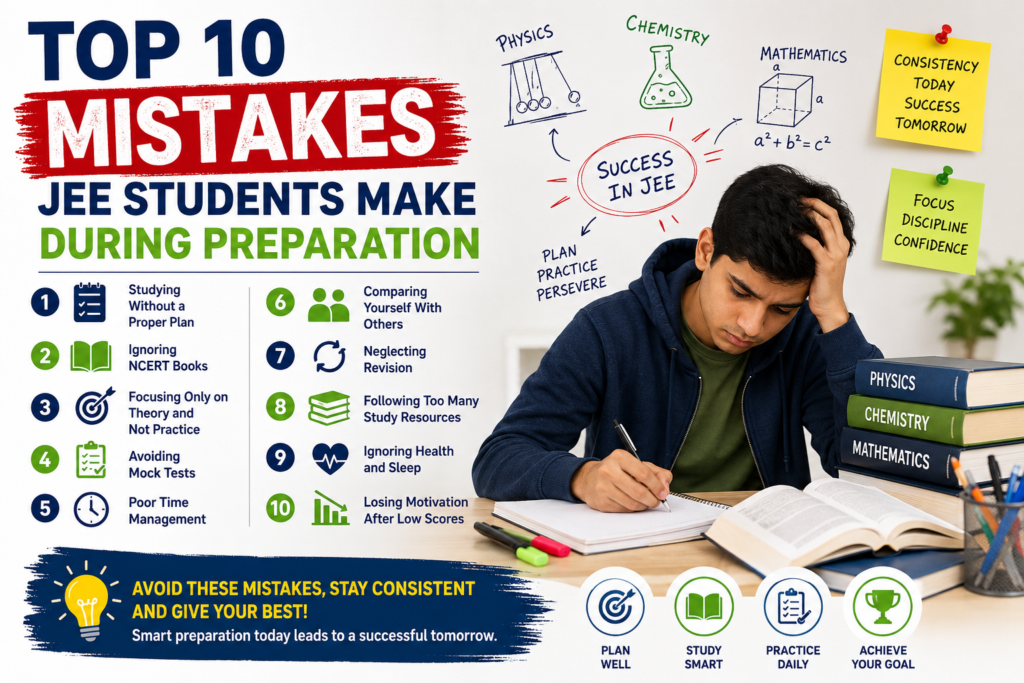
Preparing for the Joint Entrance Examination (JEE) is one of the most challenging academic journeys for students aiming to secure admission into prestigious engineering institutes like the IITs and NITs. Every year, lakhs of students appear for JEE Main and JEE Advanced, but only a small percentage achieve their desired rank. While hard work and intelligence matter, avoiding common preparation mistakes is equally important.
Many students study for long hours but still fail to achieve the expected results because of poor planning, inconsistency, stress, or ineffective study techniques. Understanding these mistakes early can help aspirants stay focused, improve productivity, and maximize their performance.
In this blog, we discuss the top 10 mistakes JEE students make during preparation and how to avoid them effectively.
1. Studying Without a Proper Plan
One of the biggest mistakes students make is starting preparation without a structured study plan. Random studying often leads to incomplete syllabus coverage, poor time management, and confusion.
Why This Is a Problem
- Important topics get skipped
- Students spend too much time on favorite subjects
- Revision becomes difficult later
- Panic increases near exams
How to Avoid It
Create a realistic daily and weekly timetable. Divide your preparation into:
- Concept learning
- Problem-solving practice
- Mock tests
- Revision sessions
Maintain balance between Physics, Chemistry, and Mathematics to ensure equal preparation.
2. Ignoring NCERT Books
Many students jump directly to advanced reference books and coaching modules while ignoring NCERT textbooks. This is especially harmful for Chemistry preparation.
Why NCERT Matters
- JEE Main includes many NCERT-based questions
- Fundamental concepts are explained clearly
- Inorganic Chemistry heavily depends on NCERT
How to Avoid It
- Read NCERT thoroughly before advanced books
- Highlight important formulas and concepts
- Revise NCERT multiple times
Strong basics always lead to better problem-solving ability.
3. Focusing Only on Theory and Not Practice
Understanding concepts is important, but JEE is ultimately a problem-solving exam. Many students spend excessive time reading theory and very little time solving questions.
Consequences
- Slow problem-solving speed
- Poor accuracy in exams
- Difficulty handling tricky questions
How to Avoid It
For every topic:
- Learn the concept
- Solve basic questions
- Move to advanced-level problems
- Practice previous year questions
Consistency in problem-solving improves speed and confidence.
4. Avoiding Mock Tests
Some students delay mock tests because they feel underprepared. This is a major mistake.
Why Mock Tests Are Important
Mock tests help students:
- Understand exam patterns
- Improve time management
- Identify weak areas
- Build exam temperament
Common Mistake
Students give tests but never analyze them properly.
Correct Approach
After every mock test:
- Analyze mistakes carefully
- Identify weak topics
- Reattempt incorrect questions
- Track progress regularly
Mock test analysis is often more important than the test itself.
5. Poor Time Management
JEE preparation requires balancing:
- School studies
- Coaching classes
- Self-study
- Revision
- Practice tests
Without proper time management, students often feel overwhelmed.
Signs of Poor Time Management
- Incomplete daily targets
- Constant backlog
- Lack of sleep
- Stress and anxiety
How to Improve
- Set realistic daily goals
- Use short study sessions with breaks
- Prioritize difficult topics during peak focus hours
- Avoid wasting time on distractions
Smart study is more effective than studying for extremely long hours.
6. Comparing Yourself With Others
Many students constantly compare their marks, study hours, or ranks with friends or online toppers. This creates unnecessary pressure and self-doubt.
Why This Is Harmful
- Lowers confidence
- Creates anxiety
- Reduces productivity
- Causes loss of motivation
Better Approach
Focus on:
- Your own improvement
- Consistency
- Personal weak areas
- Gradual progress
Every student has a different learning speed and strategy.
7. Neglecting Revision
Students often keep learning new topics but fail to revise older ones regularly. As a result, concepts are forgotten over time.
Why Revision Is Critical
JEE syllabus is vast. Without revision:
- Formulas are forgotten
- Accuracy decreases
- Concepts become weak
Effective Revision Tips
- Revise weekly and monthly
- Maintain short notes
- Create formula sheets
- Solve mixed-topic questions
Regular revision strengthens long-term memory.
8. Following Too Many Study Resources
In today’s digital age, students have access to endless books, YouTube channels, apps, and study materials. Many aspirants keep switching resources frequently.
Problems Caused
- Confusion between methods
- Lack of depth in concepts
- Wasted time
What Students Should Do
Stick to:
- Limited trusted books
- Coaching material
- Previous year papers
- NCERT textbooks
Quality matters more than quantity.
9. Ignoring Health and Sleep
Many students sacrifice sleep and health during preparation, believing longer study hours guarantee success. In reality, poor health reduces efficiency and concentration.
Effects of Poor Lifestyle
- Low focus
- Increased stress
- Weak memory retention
- Burnout
Healthy Habits for JEE Aspirants
- Sleep at least 6–8 hours
- Eat balanced meals
- Stay hydrated
- Exercise regularly
- Take short breaks during study
A healthy body supports a sharp mind.
10. Losing Motivation After Low Scores
Every JEE aspirant faces setbacks during preparation. Low mock test scores and difficult topics can reduce confidence.
Common Reaction
- Students stop practicing
- Avoid tests
- Lose consistency
Right Mindset
Remember:
- Mock tests are learning tools
- Improvement takes time
- Consistency matters more than temporary scores
Many successful students initially scored poorly but improved through disciplined practice and proper guidance.
Final Thoughts
JEE preparation is not just about studying hard; it is about studying smart and staying consistent. Avoiding common mistakes can significantly improve your performance and reduce unnecessary stress during preparation.
Success in JEE comes from:
- Strong concepts
- Regular practice
- Proper revision
- Time management
- Positive mindset
Every student faces challenges during this journey, but disciplined preparation and the right guidance can help achieve excellent results.
At Resonance Jhansi, students receive structured academic support, expert mentorship, regular testing, and personalized guidance designed to help them avoid these common mistakes and perform confidently in competitive exams like IIT-JEE and NEET.
Stay focused, stay consistent, and believe in your preparation journey.