
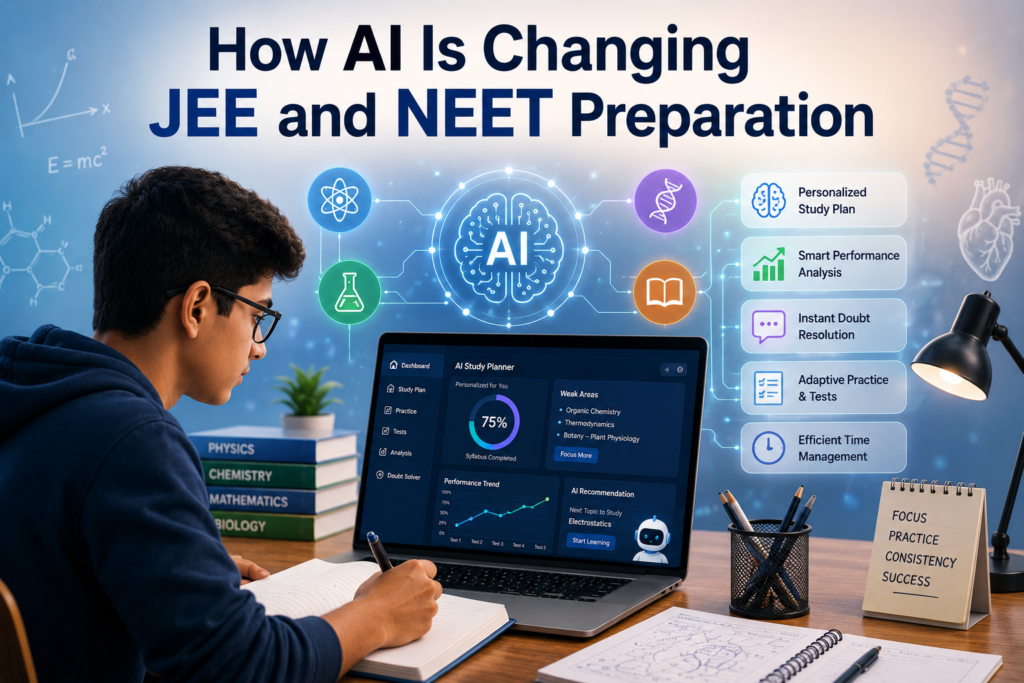
The way students prepare for competitive exams is evolving rapidly. Over the last few years, Artificial Intelligence (AI) has started transforming education by making learning more personalized, accessible, and efficient. From customized study plans to instant doubt-solving tools, AI is helping students prepare smarter than ever before.
For aspirants preparing for highly competitive exams such as JEE and NEET, where every mark matters, AI-powered learning tools are creating new opportunities to improve performance and manage preparation more effectively.
However, an important question remains: Can AI replace traditional coaching and teachers?
The answer is no. Instead, AI works best when combined with expert guidance, structured learning, and disciplined self-study.
Let’s explore how AI is changing JEE and NEET preparation and what it means for students.
Understanding AI in Education
Artificial Intelligence refers to technology that can analyze data, recognize patterns, and provide intelligent recommendations based on user behavior.
In education, AI-powered platforms can:
- Track student performance
- Identify strengths and weaknesses
- Suggest personalized study plans
- Generate practice questions
- Provide instant feedback
- Assist in doubt resolution
Unlike traditional one-size-fits-all approaches, AI focuses on creating learning experiences tailored to individual students.
Personalized Learning Is Becoming a Reality
Every student learns differently.
Some students struggle with Mechanics in Physics, while others find Organic Chemistry challenging. Traditional classroom teaching often follows a common pace that may not suit everyone.
AI helps bridge this gap by analyzing performance data and recommending personalized learning paths.
For example:
- A student weak in Thermodynamics may receive additional practice questions.
- A student consistently making mistakes in Biology diagrams may be directed toward focused revision exercises.
- Strong performers can receive advanced-level questions to further challenge themselves.
This personalization helps students use their study time more effectively.
Smarter Test Analysis
Mock tests have always been an important part of JEE and NEET preparation. However, AI has significantly improved the way students analyze their performance.
Instead of simply displaying marks and rankings, modern AI-powered platforms can provide insights such as:
- Time spent on each question
- Accuracy percentage by chapter
- Subject-wise strengths and weaknesses
- Common mistake patterns
- Predicted performance trends
These insights help students understand exactly where they need improvement.
Rather than guessing what to study next, students can make data-driven decisions about their preparation.
Instant Doubt Resolution
One of the biggest challenges students face during self-study is getting stuck on difficult concepts.
In the past, students often had to wait until the next class or doubt session to receive clarification.
Today, AI-powered educational tools can provide:
- Step-by-step explanations
- Concept summaries
- Alternate solving methods
- Practice questions related to the topic
This immediate support helps students maintain momentum during study sessions.
However, for complex concepts and deeper understanding, experienced teachers still play a crucial role that technology alone cannot replace.
Adaptive Practice Makes Learning More Efficient
Traditional question banks provide the same set of questions to every student.
AI-driven systems work differently.
They continuously adjust question difficulty based on student performance.
For example:
- If a student answers questions correctly, the system gradually increases difficulty.
- If a student struggles, the platform may provide simpler questions and concept revision before moving forward.
This adaptive approach creates a more effective learning experience and prevents students from becoming overwhelmed.
Better Time Management Through AI
Time management is one of the most important skills required for JEE and NEET success.
AI-powered planners can help students:
- Create daily study schedules
- Set realistic goals
- Track syllabus completion
- Monitor revision cycles
- Prioritize weaker subjects
Many students struggle because they spend too much time on familiar topics while neglecting difficult chapters.
AI tools help create a balanced preparation strategy based on actual performance data rather than assumptions.
AI-Powered Revision Techniques
Revision is often the difference between average and exceptional performance.
AI is helping students revise more efficiently through techniques such as:
Spaced Repetition
The system identifies when a student is likely to forget a concept and schedules revision at the right time.
Smart Flashcards
AI-generated flashcards focus on topics where students need additional reinforcement.
Personalized Revision Plans
Instead of revising everything equally, students can focus more on areas where they have previously made mistakes.
These methods improve retention and reduce unnecessary repetition.
Virtual Learning Resources Are Expanding
Students now have access to educational resources that were difficult to imagine a decade ago.
AI-powered learning platforms can provide:
- Video recommendations
- Concept maps
- Interactive quizzes
- Performance dashboards
- Digital notes
- Question generation tools
This makes high-quality learning resources more accessible than ever before.
Students can continue learning even outside classroom hours.
The Role of AI in Competitive Exam Strategy
Beyond learning concepts, AI can help students develop examination strategies.
Some advanced systems analyze:
- Question selection patterns
- Speed versus accuracy balance
- Mock test behavior
- Stress indicators during assessments
These insights help students refine their approach and maximize scores during actual examinations.
Can AI Replace Coaching Institutes?
This is one of the most frequently asked questions.
While AI offers many advantages, it cannot completely replace the role of teachers and coaching institutes.
AI can:
✔ Analyze data
✔ Provide recommendations
✔ Generate practice material
✔ Offer instant feedback
But AI cannot fully provide:
- Human mentorship
- Emotional support
- Motivation during difficult phases
- Classroom discussions
- Peer learning experiences
- Real-world teaching expertise
Successful preparation often requires a combination of technology and human guidance.
Students benefit most when AI tools support—not replace—their teachers and mentors.
Challenges Students Should Be Aware Of
Although AI offers many benefits, students should use it wisely.
Potential challenges include:
Information Overload
Too many tools can become distracting.
Overdependence on Technology
Students should continue developing independent problem-solving skills.
Inaccurate Responses
AI-generated explanations may occasionally contain errors and should be verified using trusted academic resources.
Reduced Human Interaction
Competitive exam preparation also involves communication, mentorship, and collaborative learning.
Balance remains important.
The Future of JEE and NEET Preparation
As technology continues to advance, AI is expected to become an even more important part of competitive exam preparation.
Future developments may include:
- More advanced personalized learning systems
- Real-time performance coaching
- AI-powered study companions
- Intelligent revision scheduling
- Predictive performance analytics
These innovations have the potential to make preparation more efficient and accessible for students across India.
However, dedication, consistency, discipline, and hard work will remain the foundations of success.
No technology can replace the effort required to crack highly competitive examinations like JEE and NEET.
Conclusion
Artificial Intelligence is reshaping the way students prepare for JEE and NEET by making learning more personalized, efficient, and data-driven. From adaptive practice and smart revision techniques to detailed performance analysis and instant doubt support, AI offers valuable tools that can enhance preparation.
At the same time, technology works best when combined with experienced teachers, structured coaching, regular practice, and a disciplined study routine.
The future of competitive exam preparation is not about choosing between AI and traditional learning. It is about using both together to create a smarter, more effective path toward success.
Students who learn to leverage technology while maintaining strong study habits will be better positioned to achieve their academic goals in the years ahead.